Anyone Can Whistle (2001)

Book by Arthur Laurents
Music and Lyrics by Stephen Sondheim
June 14-30, 2001
ArtLoft Theatre, St. Louis
http://www.newlinetheatre.com/whistlepage.html

THE CAST
Mayoress Cora Hoover Hooper – Lisa Karpowicz
J. Bowden Hapgood – Troy Schnider
Nurse Fay Apple – Chelsea Phillips
Comptroller Schub – Michael Brightman
Treasurer Cooley – Paul Coffman
Chief of Police Magruder – Christopher Clark
Cora’s Bodyguard – Greg Coleman
Mrs. Schroeder – Cindy Duggan
Baby Joan Schroeder – Jeannie Skala
Dr. Detmold – Terry Meddows
Townspeople/Cookies – Kiné Brown, Greg Coleman, Cindy Duggan, Justin Heinrich, Alison Helmer, Tamara Kelly, Terry Meddows, Uchenna Ogu, Jeannine Skala

THE ARTISTIC STAFF
Director – Scott Miller
Choreographer – JT Ricroft
Lighting Designer – Tim Lord
Set Supervisor – Christopher Clark
Miracle Rock & Puppet Design – Todd Schaefer
Costume Designer – Russell J. Bettlach
Hair Design – Ren Binder
Box Office Manager – Steve Dohrmann
Graphic Designer – Kris Wright
Photography – Robert Stevens

THE BAND
Piano – Neal Richardson
Trumpet – Carl Nelson
Percussion – Adam Kopff

THE REVIEWS
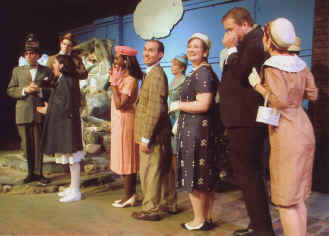
“Instead of bringing serious matters to the foreground, as he often does, director Scott Miller went all out for entertainment and let the issues emerge from a framework of farce. The resulting show offered much to enjoy on the surface without obscuring the depth.” – Gerry Kowarksy, The Sondheim Review

“The best reason to see Anyone Can Whistle, the appealing mess of a show that New Line Theatre is staging at the ArtLoft is simple. You’re not likely to get another chance. . . Still, anything by Stephen Sondheim has an element of fascination, thanks to his enormous influence on modern musical theatre. New Line’s artistic director Scott Miller, who has staged a number of Sondheim shows, directs this one with verve and intelligence. . . Miller and choreographer JT Ricroft make the most of the ArtLoft’s flexible space.” – Judith Newmark, St. Louis Post-Dispatch

“It’s a chance to see what the young Sondheim was capable of doing. There are a few excellent songs and some imaginative staging by Miller, and some of the comedy, led by Michael Brightman as Comptroller Schub, is delightful.” – Joe Pollack, KWMU-FM

“[Director Scott] Miller and choreographer JT Ricroft stage the musical numbers with brio – nicely adapting to the ArtLoft’s shallow stage and making intriguing use of aisle space.” – Cliff Froehlich, The Riverfront Times

DIRECTOR'S NOTES
When Anyone Can Whistle opened in 1964, it was so bizarre in its style, so savage in its satire, so outrageous in its social commentary that it ran only nine performances. It attacked the commercialization of religion, which still persists today, the gender and racial stereotypes that go unchallenged still today, and the blatant corruption and profiteering of politicians, which is worse today than ever. In short, it attacked the way its audiences lived their lives. No wonder it closed in a week. Musicals didn’t do that in 1964.

But the truth is those lives deserved attack, and our lives today deserve the attack even more. How is it that we condone the fact that religious titans Pat Robertson, Jerry Falwell, and Jesse Jackson are millionaires and live in mansions? What would Jesus or Gandhi have said about that? How do we condone the outrageous black stereotypes that still pervade television and movies? What would Booker T. Washington and Martin Luther King, Jr. have said about the over-sexed, drugged-out, brainless comedies full of negative stereotypes that African American writers and actors are churning out week after week? How do we condone the fact that the president of the United States, a card carrying member of the oil industry, wants to drill in the Arctic National Preserve, so he and his friends can make money? Is he all that different from Mayoress Cora Hoover Hooper?

Stephen Sondheim and Arthur Laurents address these outrages by shining the harsh light of satire on them, exaggerating them and making the insanity and insidiousness of these practices crystal clear to us all. Cora’s fake miracle gets us thinking about Dubya and his oil buddies. The black woman Martha’s stereotypical “black” dialect and her musical references to Porgy and Bess make us recognize how readily we accept black stereotypes in everyday life – still today – without even realizing it. June and John’s gender bending shows us how silly and out-dated gender roles are in our society and how far we haven’t come since the 1950s. Fay’s sex-only-by-disguise points up the hypocrisy and hang-ups Americans have over sexuality. The Cookies themselves show us how quickly we label any deviation from the norm as a sickness or disability of some sort.

Yes, this show may offend you a little, but if that’s the only way to get us all thinking about what’s wrong with our culture, then so be it. Our world is a mess and if we can laugh tonight at how ridiculous we all are, maybe tomorrow morning we can start making changes. Anyone Can Whistle creates a strange relationship between the observers and the observed. You sit watching the kooky inhabitants of Cora’s town but Anyone Can Whistle is also watching us, noticing every prejudice, every injustice, every ridiculous and selfish move we make in our everyday lives. And at the end of Act I, we’re forced to ask the literal question: who’s watching whom?

So why is the show called Anyone Can Whistle? I think it’s because this show is about the choices we make every day, about whether we do what we’re told or just go on our merry way, living life in our own quirky fashion. Whistling is a symbol of freedom, abandon, fun, and stubborn nonconformity. Most people don’t chase after those things. But anyone can.

REMEMBERING ANYONE CAN WHISTLE

Like several other shows we’ve done, Anyone Can Whistle scared the shit out of me until the second week of the run, when our audiences finally started laughing their heads off. But I’ve become a fear junkie – if it doesn’t terrify me, if it doesn’t challenge me, if it doesn’t ask things of me that have never been asked before, it isn’t really fun. I didn’t know if my ideas for Whistle would work and if audiences and reviewers would understand and embrace my take on this very bizarre absurdist musical. That first week of performances, I honestly thought I might be the only person on earth who thought this show was really funny. I asked for ridiculous, over-sized, manic performances, and the actors trusted me and gave me those performances. The audiences barely laughed that first week, but the actors still trusted me. We got mixed reviews, but they still trusted me. They trusted me and I trusted the material and that’s the only way to do theatre.

Anyone Can Whistle represents everything New Line Theatre is about – rule-busting, aggressively screwing with audience expectations, refusing to do what’s been done before, tackling difficult material that scares everybody else, demanding that audiences think and participate in the experience of live theatre. And the truth is that even if all our audiences had greeted our show with only mild chuckles – or even outright hostility – I still would have been proud of us. This show was good and the hell with anybody who says differently. They haven’t taken the time to really see all the treasure that is there, and it’s their loss. And not only was the show good, it’s also important. As I said in my program notes, maybe if we can see how ridiculous our world is, we’ll be motivated to make it better. Theatre is not just about entertainment; it’s about coming together as a community to discuss the things that need discussing. If we can’t make a difference, if we can’t make people think, if we can’t change the world, why are we wasting our time?
– Scott Miller, director

When Scott cast me in Anyone Can Whistle, I must admit to having been both excited and disappointed. I was disappointed because I had hoped to snag the leading role of Hapgood. It was a reality shock to me that I had to face the fact that at 36, I was probably too old now to play the “ingénue” roles, such as Hapgood; but felt surely I was not ready to begin playing the older, character roles; the roles I refer to as “The Mr. Mooney” roles. The shock of being cast came because I really didn't think I would get cast in any role! Although I gave what I thought was a good audition, I had some conflicts with the rehearsal schedule, and felt that it would prevent my being cast in such a large role as Comptroller Schub. But cast I was. And what a phenomenal role it turned out to be for me. I didn't know that I had it in me to play this guy the way I played him. I had a blast! Looking back, I would have never even considered playing Hapgood if I had known what fun it could be to be Mr. Mooney! I learned a great deal from doing this show, but what I learned the most is that the largest role is not always the best role!
– Michael Brightman, “Comptroller Schub”

I really never thought I would write a piece like this about a professional theatre director. Contrary to popular belief, working with professionals doesn’t always mean you get a professional environment. It was for this reason I took a very long hiatus from musical theater after doing a full summer run of Oklahoma! in Florida. I was burned out, empty, and felt that the creative atmosphere of theatre was gone. The creative process, which I had embraced during my undergraduate studies, was displaced by budgets, production schedules, and directors who espoused logic but failed to convey art in their productions, much less protect their actors. I was also tired of this kind of direction from almost every single director I worked with: “If I’m not telling you that you’re doing anything wrong, you’re doing okay.” Who really wants to be just okay?

This brings me to Scott Miller. A mutual friend encouraged me to give New Line Theatre a go. I walked into the audition and proceeded to sing a song that didn’t sound too hard on the ears, and performed my greatest acting coup ever by convincing Scott and JT that I was a comedic actor. The fools! What separated the New Line experience for me was it felt like a return to my undergraduate years. It felt safe to experiment, play, and try different things night after night. If we went too far, Scott was there to catch us. If we weren’t going far enough, he would encourage us to go further.

I will carry two memories away from the show. The first memory is when the audience seemed to have finally gotten the show and they were responding with smiles and loud guffaws. It proved that the critics were wrong and somehow a lot of people in the past missed the genius of Sondheim and Laurents in this piece. What is the second memory? Scott Miller trying to find ways to get me in trouble by wondering out loud which female cast member was in my sights for that night.
– Paul Coffman, “Treasurer Cooley”

“What the hell have I gotten myself into!” Those were the first words I mumbled to myself as I was leaving the first read-through of Anyone Can Whistle. I could not believe that a director could read that script and still want to so passionately perform it in front of a viewing audience.
When I got home I read the script again, discussed it with my family and my friends, still not getting an answer that satisfied me as to why I should continue with this production. Finally, I got the courage to e-mail Scott about it. (Some courage, e-mail.) I had no idea what his reaction would be; after all, this was my first production with New Line. But this play sparked such a fire in me, I had to say something.

The next day I checked my e-mail. There it was, the response. I was so nervous to open it because I thought, he's going to think of me as a trouble maker and kick me out of the show. So, I opened it.

The message started off with some background knowledge about the play, which I already knew from reading the information I had received at the read-through. As I continued to read on, I got to the last couple of lines which read, “Theatre is not always meant to be comfortable. Sometimes it is uncomfortable and that is why we do it, to challenge ourselves as well as the audience.” After reading that, I had no doubt in my mind that I would do the show.

The funny thing about this situation was that I knew that about theatre. I have even done a “heated” play before about the struggle in Ireland during the World Wars. That did not affect me like Whistle. Then I thought about it. Whistle was directly making fun of all the racial stereotypes that were placed on us back then in the 60s that we still have yet to overcome today.

Once I got past that, I really began to play with the script as far as character choices were concerned. I will admit that I was still nervous about the show. Every rehearsal Scott would say, “I reeeeally need you guys to go to the extreme. Nothing can be too much for this show. Don't focus on the offensiveness; I know it is offensive; just play past it and accept it.” When Scott said that, I began to trust him because he trusted Sondheim, and that was all I needed to worry about.

When that show opened, we did not at all know how that audience would respond to the show. Scott was even a little nervous, but once we opened, I think all of a sudden it just clicked for everyone. It was so AWESOME!!! From the characters, to the pace, to the lines, to the music! Don't get me wrong; I felt good about it in rehearsal, but the audience really made the difference, especially in this show. I am glad that I stuck with it.
-- Tamara L. Kelly

Cabaret (2001)

Book by Joe Masteroff
Music by John Kander
Lyrics by Fred Ebb
based on Berlin Stories
by Christopher Isherwood
March 15 – April 7, 2001
ArtLoft Theatre, St. Louis
http://www.newlinetheatre.com/cabaretpage.html

THE CAST
Cliff Bradshaw – Todd Schaefer
Ernst Ludwig – Christopher “Zany” Clark
Fraulein Schneider – Mo Monahan
Fraulein Kost – Deborah Sharn
Herr Schultz – Arthur Schwartz
Sally Bowles – Robin Kelso

The Kit Kat Klub
Emcee – Christopher Crivelli
Hansel/customs officer – Jim Hannah
Bobby – Bruce Ortiz
Victor – Terry L. Love
Rosie – Nicole Trueman
Lulu – Beck Hunter
Frenchie – Bradley Calise
Texas – Stacey Guenther

THE ARTISTIC STAFF
Director – Scott Miller
Assistant Director – Michael Leicht
Choreographer – JT Ricroft
Lighting Designer – Mark Schilling
Set Designer – Todd Schaefer
Costume Designer – Betsy Krausnick
Stage Manager – Amy Francis Schott
Master Electrician – Tim Lord
Box Office Manager – Steve Dohrmann
Graphic Designer – Kris Wright
Photography – Robert Stevens

THE BAND
Piano – Brad Hofeditz
Trumpet – Paul Hecht
Trombone – Terry Kippenberger
Bass – Dave Hall
Percussion – Adam Kopff

THE REVIEWS
“A small spotlight falls on a door, slightly ajar. A hand reaches out, showing off black-polished nails. The index finger beckons seductively. Then the middle finger signals. With that opening moment, director Scott Miller condenses his entire approach of Cabaret – tempting, vulgar, shrewdly theatrical and admirably economical. It’s one of the most powerful productions that Miller’s company, New Line Theatre, has ever staged. . . [The band’s] raw sound suits the mood that Miller and choreographer JT Ricroft evoke in steamy Klub numbers like ‘Money’ and ‘Two Ladies,’ visually exciting and metaphorically explicit. We’re in a very sick world. . . Christopher Crivelli’s venomous performance as the Kit Kat emcee sets the standard for this show – leering, cold, totally in control. Robin Kelso plays the English star of the club, Sally Bowles, with a lot of flair both in her ‘onstage’ scenes (more pose than talent) and her ‘offstage’ scenes (more pose than heart). Yet her winning, tiny smile, coupled with occasional bursts of warmth, complicates the character. You can’t dismiss her, and you can’t trust her. It’s a provocative combination. . . But the cold heart of the play lies in the Kit Kat Klub ensemble, whose entertainments reveal a morally bereft world-view that still can frighten us. And should.” – Judith Newmark, St. Louis Post-Dispatch

“I’m sitting in the front row of the most remarkable production to hit St. Louis this season. . . We’re close enough that this once familiar musical is transformed into something quite unlike any production of it you may have seen. It’s Cabaret . . And it’s one of the best things I’ve seen the New Line Theatre do. . . Director Scott Miller has made his New Line Theatre a St. Louis institution, and I’m happy to see that it has so vibrantly survived the loss of the St. Marcus. It is very much at home in the Art Loft Theatre on Washington. Besides his deep understanding of musical theatre, Miller’s chief gift, I think, is for the gathering of outstanding talent.” – Steve Callahan, KDHX-FM

“A must-see for anyone who is interested in theatre in St. Louis.” –Gerry Kowarsky, St. Louis Post-Dispatch

Cabaret, at the New Line Theatre, is a flawed but noteworthy production of the groundbreaking musical, which is as fresh and provocative as it was when it was created in 1966. The production is at its strongest in the musical numbers, all staged deftly on the tiny clublike stage by director Scott Miller and choreographer JT Ricroft. Vocally, the cast is first-rate [and] the band excellent (the accordion is a nice touch). . . In the opening number, ‘Wilkommen,’ the over-rouged, zombielike Kit Kat girls and boys, and their Emcee (Christopher Crivelli) perform enough pelvic thrusts and simulated oral sex for several productions. We’re supposed to be shocked, shocked, but the gestures are so mechanical and contrived that they become boring and meaningless. Perhaps that’s what director Miller intended: Sex has become common currency, as devalued as the German mark.” – Brian Hohlfeld, The Riverfront Times

DIRECTOR'S NOTES
Why is New Line Theatre, a company known for presenting world premieres and St. Louis premieres of new works, producing a thirty-five-year-old musical?

That’s simple. Because it still matters. Because there are some lessons in life so important we must revisit them from time to time.

So what does Cabaret have to teach us in 2001? That it’s not okay to ignore what’s going on around us, that we cannot allow our world to be less than it should be, that we should never keep quiet, that it’s important to participate, that we have a responsibility to each other and to our community, that any discrimination, any indignity, any prejudice, no matter how slight must be brought out into the light of day and condemned.

What would have happened in Germany in the early 1930s if more people had voted? What would have happened if people like Sally Bowles had paid attention to what was happening in the Reichstag? What would have happened if people like Fraulein Schneider had stood up and said loudly and decisively that they will not accept intimidation, that they will not be bullied, that they will not go along in the name of self-preservation? What would have happened if the people of Germany had listened more closely to the Nazis and then stood up and denounced Adolf Hitler for the madman he was?

Would things have been different? I really don’t know.

But there was some moment, some point of no return, when the Germans could have gone down a different road and saved the world from the horrors that should not have been inevitable.

Cabaret is about that moment, a time when it wasn’t yet too late, when Germany wasn’t yet locked into the path that would lead to the murder of millions of Jews. But the people of Germany couldn’t see what we see. They didn’t know how their choices, their fears, their apathy would lead to bigger things. People like Fraulein Schneider and Fraulein Kost were busy just trying to survive. People like Sally Bowles were busy having too good a time.

The extermination of the Jews started small, in tiny, daily indignities, in little, nearly unnoticeable acts of prejudice, in seemingly innocent jokes, in the words people chose. Could the same thing happen today? Of course it could. Right wing political leaders in America today say pretty much the same things the Nazis said about gays, women, family, religion, culture, education, and patriotism. It may not seem dangerous right now, but it didn’t seem dangerous in Germany in 1930 either.

We have an obligation to learn from what happened in Germany. We have an obligation to make different choices. If we don’t do it today, it may be too late tomorrow.

REMEMBERING CABARET

What an incredible experience this was for me. I had the distinct pleasure of being involved with one of the most talented group of people I have ever worked with – their creativity; their openness and responsiveness made Cabaret an event in my life that I will never forget.

I was given the role of the Emcee. It was a role of a lifetime. Now, I am keeping this all in its proper perspective. This is a professional company that uses this small space in downtown St. Louis. This is certainly not the big league. However, given the quality of the production, it very well could have been.

I auditioned for Scott Miller, and all the while I was thinking about Joel Grey in the movie. Mind you, I had not seen the stage revival. I was cast, and soon after, we had our first rehearsal. At that time, JT Ricroft, our choreographer extraordinaire, came to me and said, “In this number (Two Ladies), we would like for you to drop your pants and show your bare butt to the audience. Oh, and you need to grab each other’s crotches in one part of the song as well.” Okay, this was not the Joel Grey Emcee. I think I just entered a new dimension, and I am in for a wild ride. And I was right.

Scott’s vision of this production took all of us into the dark, deep, and seedy side of Berlin in the early 1930s. He opened doors for all of us, digging into our fantasies and stretching us all in body and mind. This was an amazing group of actors that just clicked. The result was an outstanding production which left a lasting impression on us all, one that we will rarely be able to duplicate in our lifetimes.

Scott knows how I feel about him as an artist and as a person. He gave me the ability to create and to stretch myself as an actor beyond what I thought I was able to accomplish. The fulfillment is one that I will keep with me forever. For the past twenty years I had dreamed of playing this role, and Scott allowed this small dream to be realized.

I personally have to thank Scott for his artistry in making this a special experience for me, and I know I can speak for the rest of the cast as well. New Line is a great venue for pushing the limits of theater. And with Scott at the helm, I know the St. Louis audience will experience the very edges of theater for years to come. I can’t wait to be part of the next New Line experience.
-- Christopher Crivelli, “Emcee”

Betsy, the costumer, was at rehearsal to take measurements for the costumes. She entered the room just as we were beginning to run the opening number, “Wilkommen.” I hadn’t seen Betsy in quite some time, so I went over to say hello and tell her how happy I was to see her. I knew she was there for costuming, but she had no idea why I was there. Actually, she thought I was in the show. As the number progressed, I noticed a look of horror on her face. At first I thought she wasn’t feeling well, until she leaned over and asked me a question, somewhat in confidence: “What sick mind created that number?” After showing a guilty grin and feeling satisfied that I had received my first confirmation that the number was going to work, I looked at her and simply smiled. No words were necessary. Ahhh, my work is complete.
– John Ricroft, choreographer

Life is a grope-fest, ol’ chum. That’s right. Grope-fest. I’ve never before been rubbed on, rubbed myself on, and groped so many so often. When J.T. began to teach us the choreography for the opening number, “Wilkommen,” everyone was a little hesitant at first. After a shy crotch grab here, and a nipple tweak there, the awkwardness dissolved. By the end of the run, grinding on someone was second nature. I’ve also never before or since had the pleasure to work with such a talented group of people, across the board. Every single actor with whom I shared the stage had something unique and amazing to bring to the production. The direction, choreography, the band – it was all pretty amazing. From on stage to behind the scenes. And speaking of backstage, one of my favorite backstage antics had to have been the “boy ballet” – Terry would partner Bruce during “Why Should I Wake Up?” It was really quite lovely.
– Stacey Guenther, “Texas”

I remember staging the opening number, “Wilkommen.” I knew I wanted to make a statement during the first few minutes. How can I capture the audience’s attention and accurately portray the decadence of that time and place that’s so important to the story? Simulated Sex on Stage! Yeah, that’s the ticket! So, I asked the chorus to break up into groups of twos and threes, so that we had three clusters around the stage. I then asked each group to come up with three “positions” that would present a graphic picture and I gave them fifteen minutes. During this time, I began to feel concerned about two cast members (Bruce and Steve) who were rather young, and were off on their own. They were talking to each other quietly and looking somewhat confused. I began thinking, would they be able to create something that fit the rest of the group? I went to each group and asked them to strike each position on count. Group 1, GO! Great job! Group 2, GO! Again, perfect. Okay, now it’s Bruce and Steve’s turn to show their stuff (no pun intended). I was fully prepared to witness something that would need some help and be adjusted. I just knew that they weren’t going to be able to come up with something. Group 3, GO! Much to my surprise, they did just fine. All I remember is during the two other groups’ turns at displaying their “acts,” there was tons of laughter and joking. Once Bruce and Steve began, I heard complete silence. The room was speechless and shocked. Mouths were open in amazement. It was perfectly clear that Bruce and Steve knew exactly what they were doing…
-- John Ricroft, choreographer

A New Line Cabaret (2000)

a world premiere revue
September 18-19, 2000
Sheldon Concert Hall, St. Louis

THE CAST
Karl Berberich
Chris Brenner
Colin DeVaughan
Cindy Duggan
Lisa Karpowicz
Robin Kelso
Robb Kennedy
Mo Monahan
Angela Shultz
John Rhine
Johanna Schloss
Leo Schloss
Deborah Sharn
Kimi Short
Keith Thompson

THE ARTISTIC STAFF
Director - Scott Miller
Lighting Designer - Amy Francis Schott

Hair (2000)

Book and Lyrics by
James Rado and Gerome Ragni
Music by Galt MacDemot
June 8 - July 1, 2000
ArtLoft Theatre, St. Louis

THE OSAGE TRIBEDavid Aikman, Kiné Brown, Bradley Calise, Karl Brian Clark, Alexis D. Coleman, Ken Haller, Justin Heinrich, Beck Hunter, Robin Kelso, Terry L. Love, Mo Monahan, Uchenna Ogu, John Rhine, John Sparger, Nicole Trueman

THE ARTISTIC STAFFDirector – Scott Miller
Lighting Designer – Paul Summers
Costume Designers – Justin Heinrich, Bradley Calise
Set Designer – Karl Berberich
Stage Manager – Amy Francis Schott
Box Office Manager – Steve Dohrmann

THE BANDPiano/Conductor – Scott Miller
Lead Guitar – Dale Hampton
Rhythm Guitar – M. Joshua Ryan
Bass – Darin Johnson
Trumpet – Paul Hooper
Percussion – Adam Kopff

THE REVIEWS
“A gripping production from New Line Theatre. . . The in-the-round presentation, with actors running through the audience, suits director Scott Miller’s intense style. His production moves with the studied emotional focus of a dream – or a memory. . . And this production perfectly captures the deep, genuine anger that the Vietnam War provoked at home. ‘Three-Five-Zero-Zero,’ a song in which the hallucinating Claude envisions his hippie friends falling in battle, is a stunning depiction of how immediate the threat felt to people a world away from the war.” – Judith Newmark, St. Louis Post-Dispatch

“New Line Theatre’s production of Hair, which opened last weekend in the A.E. Hotchner Drama Studio on the Washington University campus, may pull you into a gallop down memory lane (if you’re older) or (if you’re younger) may cause an attack of envy because your parents lived in much more interesting times than you do. Whatever the effect, a strong, musical cast make the book, music and lyrics seem as fresh and fun as they were in 1968.” – Harry Weber, The Riverfront Times

“At once historical and iconoclastic, this classic hippie postcard from the summer of love remains as brittle and quirky as ever, but the New Line production reveled in the shaggy spirit, and proved largely enjoyable.” – Brian McCary, KDHX-FM

DIRECTOR'S NOTES
It is 1969 and the youth of America are lost.

Their parents, still celebrating the prosperity that followed World War II, have raised social drinking to an art form, they are bathing in the excesses of capitalistic materialism, and they are showering their children with everything anyone could want – except the nourishment of the soul.

These young people have all the physical trappings of happiness but don't know who they are, where they belong, what is expected of them. More of them are going to college than ever before, where they learn to think independently, to question the status quo, and to reject their parents' long-held, arbitrary definitions of morality, success, and happiness. These young people see racism run ranlpant in America, with lynchings still common in the South. They see American youths shipped off to southeast Asia to fight a war which has nothing to do with America and which appears to be unjust, immoral, racist, and impossible to win. They see disregard for the environment in the unchecked progress of American industry. And they see a culture that now worships at the feet of a new God – consumerism.

What do these kids want? They want to erase all the rules and start over, creating a new society that makes sense, one built on the idea of celebrating all the wonderful, magical, indefinable things that make us human, the things that unite us, the things that join us to the rest of the natural world. They ask why we have such restrictive rules of sexuality. Is it because some long ago culture wanted to control inheritance? Or was it about the perpetuating of a particular ethnic group? Why do we have such restrictive rules about drugs? Is it because once we taste the liberation of mind-expanding substances, we'll be harder to control? Why do the adults who drink like fishes at cocktail parties so self-righteously condemn marijuana? Why do they so strongly condemn all drugs, when so many other cultures highly value the ritual use of hallucinogenic drugs to achieve a higher level of consciousness and to find God? Why do so many people call themselves people of faith but act in such immoral ways?

Our tribe has not come to insult you or the values you hold dear. Our intention is not to shock or upset -though we may do that too. We have come to celebrate our humanness, the joy of living, our connection to each other and to the world around us, our God given sexuality, and the wonders and mysteries of the human mind and body.

We have come to ask you to join us in rejecting violence, hatred, fear, and judgement wherever we find it, to question the way things have always been, to look at the world with a fresh eye and to resolve to change the things that need changing.

Especially here and now, in the year 2000, an election year, consider whether we need more guns in the world, whether we value our children enough, whether we value our freedom enough, whether we value our planet enough, and whether people should be discriminated against because of the way they look or who they fall in love with.

It is a new age. Everything is ready. It's time to change the world.

REMEMBERING HAIR

Hair was the first show I have ever done where I really felt as though I was saying something important; and, perhaps even more importantly, it was the first show I have done where I really believed in what I was saying. Though the show is over thirty years old, any criticisms about the show being “dated” have never held much weight with me. While the main conflict (Vietnam) is no longer being fought, the scars of that war live on to this day, just as many of the other issues in the show do (racism, acceptance of those different from you, the ridiculous and arbitrary way society stigmatizes all recreational drugs). As I became more and more involved in the show, everything we were fighting for in the show became more important to me, and I actually began to understand how it must have felt when people began reaching out to one another in the sixties, with the hopes that they would actually make the world a better place.
– Bradley Calise, “Margaret Mead”

My relationship with Miller began just over ten years ago. I was a bright-eyed, clean shaven optimist a year out of college who thought, after one too many drinks most likely, I was to be an actor. Miller cast me in my first St. Louis show, Deathtrap, a play he was producing for another company while finding his way with New Line. It was only my second show, but he gave me a shot as the manipulative Clifford, and my acting career was on its way.

The next seven years snaked me from local to regional stages, to national tours, and finally landed me in L.A. for a spell struggling in film and television and honing my extracurricular skills. I retired from acting at the ripe old age of thirty and moved back to St. Louis. And there I found a thriving theatre community with New Line as one of the major players.

Chances are I would’ve stayed from the footlights, happily grinding the stone at a warehouse, had it not been for an audition notice in the RFT – HAIR, the Tribal Love Rock Musical from the late ’60s to be produced by New Line and directed by Miller. A show I had always wanted to perform, but never had the opportunity. I couldn’t pass on at least auditioning.

Whether Miller had been drinking or smoking too much on the evening of his final casting, he graced me with the role of Berger – a decision that will forever bond me in his creative and artistic debt. A role that enabled me to exorcise some demons within. A show so powerful as to compress yet amplify scores of emotions for those who experience it.

Hair is a show in which the Whole is certainly nothing without its Parts, but also where the Parts are nothing unto themselves until summed. Yes, we all know “Aquarius” and the title song “Hair,” and most of us recognize “Easy to be Hard.” But the book itself is a series of mostly non-linear nonsequitors strung out in a drug-induced mélange thinly plotted against the political and cultural climate of the times. Or is it?

The rehearsal process was none as I had ever encountered. At times frightening – at others liberating. The story line was confusing; the characters sporadic. A lead role was changed with less than a week before curtain. I admit I was unsure of how the final outcome would translate, but my faith in Miller never waned. On final dress, everything made sense. The power of the music and the message of the show, under the eccentric guidance of Miller, came searing through in synaptic waves. We all felt it. We all got it.

Nearly every night after rehearsal, a small group would get together for drinks and eats. I thought it important for the Tribe to bond off-stage as well as on. And although the participants shifted from night to night, Miller and I were steadfast. This gave us a wonderful opportunity, outside of rehearsals, to discuss and dissect not only the show, but a multitude of topics relating in large and small or none at all ways. And through this discovery and revelatory process, Miller was able to instill acceptance and trust and fuel me to portray what I hope was a truthful performance.

As for the show itself, he brought out the passion and power that it truly possesses. He dug to the core and revealed the moral meaning behind it all. Propelled by an improvisationally talented group of musicians, a subtle yet dramatic lighting design and the freedom of a skeletal set, Miller brought Hair to life and drove it marching and protesting into the hearts/minds/souls of those in the seats. And as with all the pieces I’ve seen New Line produce and Miller direct, he gave audiences the Truth. Not one person who experienced this show, be him spectator or performer, walked away unaffected.

Did I experience change? Certainly. Will I perform again? Hard to say. But Hair definitely puts a helluva capper on a spotty, sporadic decade of performing. I am emphatically proud of that show and am honored to have been a part of it.

And although New Line revived the show the following summer, there were changes in my life that made me unable to get on the bus. A month after we closed Hair, I became a father. Unfortunately, the geographical location of my baby boy, Nicholas, was not in St. Louis. Therefore, a move by me was imminent. It’s possible I could’ve worked out the logistics to allow me to perform in Hair 2001, but there was another reason that kept me away.

As I’ve said, I always wanted to do Hair. And truth be told, I’d always wanted to perform the role of Berger – that free-spirited, make love not war, primordially driven wild man. And in the summer of 2000, I accomplished just that. But to do so, I had to confront a lot of characteristics and behaviors, emotions and issues I had experienced in the not so distant past. Hair 2000 was in no small part a huge therapy session for me. I learned a lot that summer – about myself, and about others. And I have Miller and the entire cast (and, of course, Hair) to thank.

But to reprise the role of Berger for another production would’ve tainted the seminal experience I had had. It would’ve been too painful, and I would not have been able to do the character, and ultimately the show, justice. The tools I had used to embody him were no longer available to me, and my performance would’ve been merely perfunctory. And to me, that is unacceptable.

However, I was able to come back and see Hair 2001 as an audience member. And Berger, Claude, the entire tribe and band were a treat to behold. They had taken it to yet another level. And that made me smile immensely.

I may never have the opportunity to work with Miller and New Line again, but I cherish the moment when I did. They do important work for the St. Louis community. They bring forth Honesty and Integrity with each production they stage. Support this company. Support the Arts. Without them, we are pedestrian. Without them, we are empty.
Peace and Love,
John Sparger
aka Sparger Berger
Hair 2000

I could scarcely contain my surprise when Hair really came together, and I do mean in a big way. Not only were our audiences totally digging our performances, but as a group, our Tribe was bonding in a way that no one expected. The myth that “doing Hair will change your life” was really true. I cried myself nearly to sickness and shrieked myself hoarse each night because the show and the pain of experiencing that life had become so real to me. I wasn't just playing Jeanie; I was her, and these were my dear friends who were being sent to fight a war, many never to return. And while I often can't verbalize the power this show has on those of us who are lucky enough to bring it to life, I choose to think of our Tribe as messengers. Messengers who had only one month to share our knowledge with as many people as we could.
– Beck Hunter, “Jeanie”

Scott Miller cast me in his 2000 New Line Theatre production of Hair as Claude despite the fact that I'm twice the age of the character and have short hair. The hair, as it turns out, was not such a big deal. Since Claude returns at the end of the play as a short-haired specter in an Army uniform, wearing a wig was very appropriate to play him. Now, I know nothing about wigs. Where would I go, then, to find a wig that would not only look good but would stand up to a punishing evening on stage?

Obviously, to a drag queen.

My friend, Michael, is well known in the St. Louis drag community as his alter ego, the ultra-glamorous Erica Fox. Since Erica had won the Miss Missouri Entertainer of the Year award on more than one occasion, I knew Michael/Erica would be my first choice as wig guru/gura.

“Sure, Ken, come on over!” Michael said when I called to ask his help. “I'm sure we can find something that'll work for you.” When I arrived at his apartment, Michael had three or four wigs out on the kitchen table for us to consider. He gave me an appraising look and said, “I think this is the one for you.” He picked up a center-parted, shoulder-length chestnut number and arranged it on my head. He stepped back and looked. “That's it!” he exclaimed, sweeping up the other wigs and putting them back in their boxes. “That's the wig for you.”

“Really?” I asked, looking at my reflection in a hand mirror, unused to seeing my face framed by so much hair since I had been, well, Claude's age.

“Yes, really,” he said, scooping it off my head. “Now, let me show you how to clean it.” Clean it? There are instructions for how to clean it?

“First,” he said, turning on the faucet in the kitchen sink, “fill the sink with warm water. Then add a capful of . . .”

“Shampoo?” I interrupted.

“No. Mr. Clean.” He reached under the sink and poured the cleaning fluid into the sink.

“Mr. Clean!?!” I said, more loudly than I'd intended.

“Hon,” he said, turning with a Bob Fosse hip-pop, the wig draped over his right hand, “this wig is made out of the same stuff as this floor,” his left hand pointing at the linoleum. He turned back to the sink, demonstrating as he talked. “Place the wig in the water and gently swish it back and forth. Now run your fingers through it. As you lift it out, gently squeeze the water out. Do not wring it out! Now, to give it a really nice sheen, put fresh water in the sink and add a capful of. . .”

“Uh, conditioner?”

Michael gave me one of those how-could-someone-so-stupid-be-a-doctor looks. “No,” he said slowly, “Murphy's Oil Soap.”

“Murphy’s Oil Soap!?!”

“Do you want my help or not?”

“Sorry.”

He repeated the process with the furniture polish and concluded, “You dry it like this,” taking the wig outside, holding it over his head, and slinging it forward and around with the force of a lesbian softball pitcher. He turned and looked at me sternly. “You never use a hair dryer. Why?”

“Uh, it would melt?”

He smiled. “Now you're getting it.”

I followed Michael's regimen faithfully, subjecting the space-age polymer hairpiece to harsh chemicals before each weekend of our run, and, like the phoenix, it rose in glory each time.

While I'm sure the wig fooled no one into thinking I had seriously long hair, and while I'm sure no one thought I was really in my twenties, it all worked. When Claude returned to the stage in the final scene, dressed now in an army dress uniform, hair now in a buzz cut (my real hair, dyed to match the wig), I could hear people in the audience gasp, and as I sang the plaintive last reprise of “Manchester, England” in counterpoint to the protest song of the Tribe, I could hear them start to cry.

But that's New Line. While some people need chandeliers, roller skates, and helicopters, New Line just needs an authentic, aging hippie and a linoleum wig to create magic.
-- Ken Haller, “Claude”

I put Hair into our season without really knowing much about it, aside from its more famous songs and its movie version, which I knew was very different than its stage incarnation. Luckily, early in the rehearsal process, I discovered online a discussion list about the show that included among its subscribers members of the original Broadway cast and Michael Butler, the show’s original Broadway producer. Thank God for them. Learning the music was easy enough (though I’m glad I didn’t have to memorize any of those list songs). But once we started blocking the show, I was lost. The script didn’t make sense. There were virtually no stage directions. I found the archives of the discussion list and read every post. I started asking lots of questions. And slowly the show started making a little bit of sense. Their best advice was to Trust the Show. The rehearsal process became a kind of spiritual journey, a test of my trust. I did as they asked. I stopped worrying about the show. I stopped wondering how we would pull it off. I had trust. And I think it was that trust that kept the actors from freaking out completely. Despite the fact that they didn’t think it could ever come together, they saw no worry in me. And sure enough, once we the put the show on its feet and once we got it in front of an audience, almost everything started making sense. We found all the emotion, all the spirituality, all the genius of this wild and weird show. But I owe Michael Butler, Nina, and others on that Internet list a great debt of gratitude. Hair changed my life.
--Scott Miller

Out on Broadway 2000 (2000)

a world premiere revue
conceived by Scott Miller
featuring songs from Rent, Grease, A New Brain, Songs for a New World, Jesus Christ Superstar, Ragtime, Little Shop of Horrors, Newsies, Cabaret, Guys and Dolls, Faust, Follies, Fiddler on the Roof, The King and I, and other shows
March 9 - April 1, 2000
St. Marcus Theatre, St. Louis

THE CAST
Chris Brenner
Tracy Collins
Robb Kennedy
Keith Thompson
Eddie Webb

THE ARTISTIC STAFF
Director – Scott Miller
Lighting Designer – Amy Francis Schott
Costume Consultant – Tim Kent
Box Office Manager – Steve Dohrmann
Graphic Designer – Tracy Collins
Pianist – Scott Miller

THE REVIEWS
“At least the quirky little [St. Marcus] theater is going out in style. Scott Miller's revue, which presents musical theater songs in a gay context, has graceful, small-scale proportions, just right for this theater in terms of music, voice and staging. Furthermore, the show's message – a plea for tolerance, particularly in regard to sexual orientation – is a fair summation of the point that many St. Marcus shows have made. . . Miller even works in “Danny Boy.” But the ensemble rendition changes the terms so drastically that “Danny Boy” gains fresh meaning, tender and powerful. The song underscores the value of shows like this one: They reveal the familiar in a fresh light. Audiences need places that offer us that perspective.” – Judith Newmark, St. Louis Post-Dispatch

Out on Broadway 2000, Scott Miller's beguiling assemblage of show tunes, looks like a lot of fun to do. . . This show makes you want to dish about the wise and witty performances of each singer.” – Sally Cragin, The Riverfront Times

“The gimmick sometimes works too, culling surprises from familiar lyrics when placed in a new context. I discovered I'd never really listened to the lyrics of ‘Far From the Home I Love,’ from Fiddler on the Roof, until I heard it in Out on Broadway 2000.” – Bob Wilcox, KDHX-FM

“New Line Theatre's Out on Broadway 2000 gender-reversed Broadway and cabaret standards and provided dreamy entertainment. All that was missing was the clink of ice cubes and a blue haze of cigarette smoke.” -- The Riverfront Times, “Best of 2000”

DIRECTOR'S NOTES
When we put together the first Out on Broadway in March 1996, we had no idea that there would be such enormous public demand for more performances that we’d have to bring it back in August of that same year. We never thought there’d be a cast album. And we certainly never thought we’d be doing a sequel four years later.

But here we are.

So much has changed since 1996. Will and Grace is on television every week, getting great ratings, and three more shows with gay lead characters are planned for next season. And for good or bad, gay Americans are every bit as visible as straight Americans on Jerry Springer and the other talk shows.

Gay marriage has become one of the top issues in the country, with the Vermont Supreme Court ordering the state legislature to give gay couples equal rights, with Californians voting on a referendum against equal marriage rights for gay couples on March 7, and with the Hawaii gay marriage case still rumbling despite setbacks. In contrast, a study just released says 2.5 million gay Americans are currently in heterosexual marriages.

The issue of adoption for gay couples is coming before courts around the country. Anti-gay discrimination in groups like the Boy Scouts is being actively challenged in the courts, and in some cases, is being condemned.

As the presidential races heat up, gay issues are on the agenda everywhere you look. Both Al Gore and Bill Bradley are actively courting gay voters. And even the most conservative Republicans are being forced to acknowledge us and address our issues.

And yet, Matthew Shepard was brutally murdered in Wyoming just for being gay. Billy Jack Gaither was murdered in Georgia for the same reason. And they’re not the only ones.

One of the purposes of the original Out on Broadway was to tell gay teens and closeted gay men and women that it’s okay to be gay, that they can be gay and still be proud of who they are, that being gay is not a sickness. With all the increased visibility for gay Americans, perhaps that’s not as necessary today as it was four years ago.

The other purpose of the original show was to demonstrate how alike gay and straight people are, and how alike gay and straight love is. That is still necessary because, even though we are all alike deep down, the world still does not treat us alike. It’s amazing how easy it was for most of these songs, originally written for straight characters, to work in a gay context – but they do, precisely because gay people think and feel most of the same things as their straight friends and families. And that message can’t be spread far enough or fast enough.

So enjoy the show. Laugh along with us, cry along with us, but most importantly, remember that we are your brothers and sisters, parents, friends, neighbors, and co-workers. Remember that many of us want to marry. Some of us want to have kids. And all of us want the respect we deserve.

Floyd Collins (1999)

Music and Lyrics by Adam Guettel
Book and Additional Lyrics by Tina Landau
November 4-20, 1999
St. Marcus Theatre, St. Louis
http://www.newlinetheatre.com/floydpage.html

THE CAST
Floyd Collins – Troy Schnider
Homer Collins – Eric Whitman
Nellie Collins – Kimi Short
Lee Collins – Steven R. Johnson
Jane Collins – Mary “Mo” Monahan
William “Skeets” Miller – Dan Sattel
Bee Doyle – Karl Berberich
Ed Bishop – Michael Deak
Jewel Estes – Colin DeVaughan
H.T. Carmichael – Patrick Kerwin
Cliff Roney/Reporter – Chris Brenner
Dr. Hazlett/Reporter – Keith Hale
Reporter – John Rhine

THE ARTISTIC STAFF
Directors – Scott Miler and Alison Helmer
Assistant Director – Kevin Corlett
Lighting Designer – Mark Schilling
Costume Designer – Elizabeth Krausnick
Set Designer and Scene Painter – Karl Berberich
Set Construction Assistant – Adam Lewis
Stage Manager – Amy Francis Schott
Sound Technician – Chris Clark
Box Office Manager – Steve Dohrmann
Graphic Designer – Tracy Collins

THE BAND
Piano – Neal Richardson
Violin – Bill Bauer
Guitar/Banjo – Kathy Schottel
Percussion – Adam Kopff

THE REVIEWS
“New Line Theatre . . . continues the hot streak that began last season with Camelot and Into the Woods. Scott Miller's productions always are small in scale, but the imaginative scope of these recent shows has impressive depth. . . It offers perspective instead of self-indulgence, imagination instead of ego. It's a compelling musical and one that is well-suited to the New Line Theatre's stripped-down style.” – Judith Newmark, St. Louis-Post Dispatch

“Adam Guettel, the composer and lyricist, and Tina Landau have turned this dark, sad tale into a remarkable piece of musical theater that, although hardly flawless, is consistently interesting both in its music and in the way the story is told. . . New Line Theatre has fielded a strong cast whose vocal abilities are generally matches for Guettel's often demanding music. . . and what a pleasure it was to hear natural, unamplified voices.” – Harry Weber, The Riverfront Times

“Scott Miller's New Line Theatre company, in the small cave of the St. Marcus Theatre, is shouting out a beautiful exploratory cave call: they have been delving into the subterranean recesses of musical theatre for some years, and now they've opened a fine production that epitomizes their own search. . . The cast abounds with strong performances.” – Steve Callahan, KDHX-FM

DIRECTOR’S NOTES
Raucous comedy. Great tenderness. Muscular, powerful music. Simple folk ballads. Family, faith, metaphysics. It's all there in Floyd Collins, one of the most spectacular first efforts in the history of musical theatre.

The critics have gone wild over this show. New York's Newsday called it “one of the three or four truly great music theatre scores of the last decade.” Entertainment Weekly said, “The melodies soar... In Adam Guettel a vital new musical theatre writer has emerged.” New York Magazine said, “This is the original and daring musical of our day.., a powerhouse.” Variety said it was “easy to admire.., sometimes ravishing.” The San Diego Union Tribune called it “a daring and original piece of musical theater.” The Los Angeles Times called it “plaintive, often inspired...Adam Guettel is a composer for the new century.”

With Floyd Collins, composer-lyricist Adam Guettel (rhymes with kettle) has clearly established himself as the most likely candidate to lead the next generation into the musical theatre terrain that Stephen Sondheim has explored for the last forty years. Floyd Collins is a musical full of a complexity and sophistication worthy of Sondheim, yet also full of the emotional force that this story demands; because, though it is a story about media exploitation, greed, glory, and prejudice, at its core, it is even more about family and faith. It is one of those musicals, like West Side Story, Company, and Ragtime, which could only have been written by Americans. There is a brashness, an openness, and a muscularity in Floyd Collins that is uniquely American.

Guettel and his bookwriter Tina Landau have tackled a most unlikely subject for a musical. Most of the story takes place after Floyd has been trapped a hundred feet underground. How do you make a musical about a character who can't move? The answer is twofold. First, they realized the most compelling story here is an internal one; the almost supernatural connection between Floyd and Nellie, the powerful brotherly bond between Floyd and Homer, Floyd's indomitably American spirit, and his blind optimism in the face of incredible obstacles. Second, Guettel separated the two worlds – above ground and underground – by giving them each their own sound. Above ground, the music is an only slightly altered bluegrass Kentucky folk sound; rollicking, simple, honest. Below the surface is Floyd's world, and it has its own music. Here is where Guettel uses the sophisticated, complex sounds that owe something to the work of Stephen Sondheim; full of soaring, gorgeous melodies; unusual, quirky rhythms; and fascinating, interconnected musical themes that weave together to create a beautiful musical tapestry.

Guettel and Landau have written a musical about a real American hero, still today considered the greatest cave explorer in American history. And they've done it with such care and such skill that it ends up being one of the greatest musicals you'll ever see. We just hope we've done this magnificent work justice.

REMEMBERING FLOYD COLLINS
Several years after college I found myself far from the theatre, doing graphic design in a retail music store, when one of my coworkers, a former university music instructor, got a call from a local theatre company desperate to replace the lead in an upcoming production of Brigadoon. Aware of my background, he gave them my name; two weeks later I was performing my first role since college. That was the spark. Three more lead roles built my confidence enough that I sought out professional theatre companies, not for the money, but for the challenge. I was tired of being a big fish in a little pond, but the old fears returned. Was I good enough? I had to give it a shot, and another local actor suggested New Line Theatre. I knew nothing about them, but I trusted him and soon learned they were about to hold auditions for Floyd Collins. In my wildest dreams I never imagined a St. Louis company would take on a show this personal and this excruciatingly difficult. I clearly remember my only request on the audition form: “I just want to sing.” They cast me as Floyd, and, along with music director Neal Richardson, pushed me harder and farther than I ever dreamed. To this day I’m still shocked they had the guts to take on a show like this, but you have to realize New Line does it time and again over and over. Scott simply does what inspires him. It’s truly remarkable. The fact that he’s willing to cast someone he’s never seen before, and has the wherewithal to pull it off, astounds me. So, do I have what it takes? Who knows, that’s for others to decide, but I’ll never stop seeking out challenges and working hard. I have New Line Theatre to thank for this outlook, and Floyd Collins and many future productions to look forward to because of it.
– Troy Schnider, “Floyd Collins”

For me, the most wonderful moment of doing this show was standing backstage late in the second act while Floyd sings his last song and realizes he's going to die in the cave. For me, that was the emotional high point. When Troy would sing the line: “Will my mama be there waiting for me?” I would get shivers and have a huge lump in my throat the whole time I was saying my closing monologue. Floyd Collins was far and away the most touching show I've ever experienced. I will always cherish the memory.
– Dan Sattel, “Skeets Miller”

During the rehearsal process for Floyd Collins, Scott did a tremendous amount of research about this true story. In fact, Scott, Alison, Troy, and Amy traveled to Kentucky and saw the actual area where the show is set. They even brought back pictures and souvenirs of their trek to Floyd country. All of this reminded the cast that our characters were real people, and we got to know them a little better. But the biggest reminder happened on opening night. A group of actual cavers attended and sat in the front row with their cave helmets on. We thought that was kind of a strange thing to do and were poking fun at them backstage. During intermission, Scott talked to these folks and found out how much of a folk hero Floyd Collins is to cavers everywhere, even seventy-five years after his death. In a sense, it was like having friends of Floyd in the audience. That was pretty cool. Oh yeah, the cavers liked the show.
– Steve Johnson, “Lee Collins”

I never want to yodel again in my life. I don't think Scott would ever be happy with music that was simple and easy. And because of this, I don't think his performers would either. I have wanted to try other theater groups, but I don't. I keep thinking, “But they won't be like New Line’s shows.” I believe in what Scott does and the education in theater that he has given me. Also [I’m thankful] for the wonderful opportunities for personal growth and growth as a performer. I can never be grateful enough for all the true friendships I have made through New Line. I am proud to say that I am a part of New Line and will always be. Thank you Scott Miller.
– Chris Brenner, “Cliff Roney, Yodeler”

It was in the fall of 1999. Floyd was upon us and I took the job as set designer. I tried different ideas. In a small theatre like St. Marcus, there isn't much room for anything extensive. So I had to wing it. I needed this unit set to be a cave, a forest, a gathering area. I knew it would get done. I just couldn't calculate how well. I was in a bit of a panic. I needed to catch a vacation. I needed to really focus. I took a trip to Springfield. I knew how the set would be built, but the detail was crucial. That first night in Springfield was to be the time of clarity. I lay on my back on my friend’s floor (a bit sauced), watching a candle flicker light on the ceiling. I felt something on my side. I look down to my chest, and in the little light that was in the room, I noticed two long antennae sweeping the air. I froze. “I hate cockroaches,” I thought. All the lights go on and my friend is grabbing a shoe to kill this bug. In a flash, I realized what was on me... a cricket! I shouted, “No! Don’t kill it!” Floyd talked to crickets! It jumped off of me and disappeared into the house. In the instant I saw that cricket, I saw the detail of the set. In my head it was complete (crazy, huh?). That was a great spiritual moment for me. I believe in many Eastern beliefs and one belief is that crickets are fortune tellers, prognosticators. I had a moment of connection with something else, somewhere else. And the energy used me to create the right set. It turned out to be one of my favorite works of art to date. (Thank you, Mark, for the perfect lighting.) Floyd and my time doing that show really helped me deal with problems I had been struggling with, [helped me] shine in the face of adversity.
– Karl Berberich, set designer, “Bee Doyle”

During rehearsals for Floyd Collins, Troy, Alison, and I drove to Kentucky to see Floyd’s cave. The lady at the Floyd Collins Museum told us where the cave was in which Floyd had been trapped. We drove down the road and found a small sign by the side that said “Sand Cave.” There were no arrows, no map, no directions. We started down the dirt path, and after a few wrong turns, we finally found it – Floyd Collins’ Sand Cave, where Floyd was trapped and died, where people had argued over rescue theories, where thousands of gawkers and onlookers had assembled seventy-four years before. We found the tiny passage through which Floyd had squeezed. It was utterly magical and emotionally overwhelming. I felt like I was about to cry. I couldn’t believe we were there. It was the feeling you get standing in a beautiful cathedral. We then drove up the road further to find Floyd’s grave, and an elderly couple who had been driving by stopped when they saw us in the graveyard. The man had been a cave guide many years before and had carried Floyd’s coffin when they had moved it to that cemetery. They told us so many great stories and then told us how to find the unmarked Crystal Cave, which Floyd had opened to the public before his death in 1925. The next day, we found the small dirt road they had described, behind a locked gate. We parked and walked several miles down this road, not knowing for sure if it was even the right road. We found a couple buildings which we thought might be a house and a ticket office Floyd had built. While Alison and Troy took pictures, I found a path and ventured down it. I came across homemade stairs and a railing leading down to an entrance into a hill. I had found Crystal Cave and I screamed myself hoarse running back up to them. The entrance was sealed behind a big iron door, but when Troy pushed on the door, it opened, and to our great surprise we were able to walk inside the first chamber of Floyd’s cave, to stand on the floor he had smoothed, to breathe the air he had once breathed. It was an experience I’ll never forget.
– Scott Miller, director

What I remember most about the show is reuniting with Scott, and working with him for the first time in years. Whenever I've worked with Scott, it's always been an educational experience for me because he is so knowledgeable about the material he covers for any show he does. This was the first musical I had done since I graduated college. Since then I have concentrated mostly on music-writing, singing, and acting from time to time in various film and TV projects. So this was a welcome change of pace for me, as well as a sort of homecoming, since the musical stage is my first love. I remember everyone involved in Floyd Collins being a bit overwhelmed at first by the complexity of the material. Not just the score, but the story behind it too. This show is also a fine example of the type of material that Scott chooses for New Line, and why I believe the company has survived, and will thrive in the many years to come. New Line's productions do more than entertain people like other theatre companies or shows, where you leave the theatre afterwards, and within fifteen minutes forget what you just saw. New Line challenges the audience, and gives the audience something to think about after they leave the theatre. I'm not familiar with many other theatre companies, besides perhaps the Steppenwolf Theatre Company in Chicago, that sets the bar so high in the choosing and executing of material, whether it's a popular classic, a lesser known piece, or a world premiere of an original work; where the result is a growing and learning experience for the artists onstage and behind the scenes as well as quality entertainment for the audience. Here's to ten--and hopefully many more--years for New Line! I hope that I'm lucky enough to be a part of your process again and again in the future.
– Eric Whitman, “Homer”

The Ballad of Floyd Collins – A Parody
(To the tune of the theme song for The Beverly Hillbillies,
with parody lyrics by Scott Miller.)

Come and listen to a show about a man named Floyd,
So damn weird that you’ll prob’ly get annoyed,
All about Kentucky and a fella in a cave --
Not so very happy but it surely is brave.
(spoken)
Brave theatre. Dissonant music. Hard to understand.

At the openin’ of the show, this Floyd goes down,
Crawling on the stage, kinda squirmin’ all around,
First ten minutes, he gets trapped real tight,
And he doesn’t move a muscle for the rest of the night.
(spoken)
Long night. Just sits there. No choreography.

And that's about the size of it, the whole friggin' show,
All in all, about as fun as choppin' off your toe.
Lots of heavy drama and some really long songs,
A-weepin' and a-wailin' where the comedy belongs.
(spoken)
Just a joke or two. That's all we ask.

Now, the first thing you know, they’ll be doing it agin,
Another damn musical about a mortal sin,
More crazy melodies a-dancin’ in your head,
And sure, by the end, well, the hero will be dead.
(spoken)
Stone dead. Depressing as hell…

A New Line Songbook (1999)

a world premiere revue
Conceived by Scott Miller
featuring songs from Attempting the Absurd, Assassins, Pippin, In the Blood, Company, Sweeney Todd, Passion, Jacques Brel is Alive and Well and Living in Paris, March of the Falsettos, Songs for a New World, Into the Woods, Floyd Collins, and other shows
October 9, 1999

THE CAST
Karl Berberich, Kevin Collier, Cindy Duggan, Keith Hale, Alison Helmer, Rebecca Hunter, Lisa Karpowicz, Keith Price, Angie Reinert, John Rhine, Dan Sattel, Deborah Sharn, and Kimi Short. Hosted by Steven R. Johnson

THE ARTISTIC STAF
Director - Scott Miller
Lighting Designer - Amy Schott

Into the Woods (1999)

Music and Lyrics by Stephen Sondheim
Book by James Lapine
June 10 - 26, 1999
St. Marcus Theatre, St. Louis

THE CAST
Narrator/Mysterious Man – Steven R. Johnson
Cinderella – Sarah Laak
Jack – Adam Eisen
Jack’s Mother – Cindy Duggan
Baker – Robb Kennedy
Baker’s Wife – Deborah Sharn
Cinderella’s Stepmother – Rebecca Hunter
Cinderella’s Stepsister, Florinda – Christina Rios
Cinderella’s Stepsister, Lucinda – Johanna Schloss
Steward – Justin Heinrich
Little Red Ridinghood – Kate Novak
Witch – Laura Beard Aeling
Cinderella’s Mother/Granny/Giant’s Wife – Mary “Mo” Monahan
Wolf/Cinderella’s Prince – Karl E. Berberich
Rapunzel – Kimi Short
Rapunzel’s Prince – Sean Pritchett

THE ARTISTIC STAFFDirectors – Scott Miller & Alison Helmer
Music Director – Scott Miller
Set Designer & Scene Painter – Karl Berberich
Costume Designers – Theresa Doggett & Tim Kent
Lighting Designer – Jamie Brink
Lighting Technician – Sara Epstein
Stage Manager – Amy Francis Schott
Box Office Manager – Steve Dohrmann
Graphic Design – Laura Beard Aeling & Zachary Lips

THE BAND
Piano – Brad Hofeditz
Trumpet – Paul Hecht
Flute – Jessie Poepping
Percussion – Adam Kopff

THE REVIEWS
“With Into the Woods, [Scott Miller] continues his experiments in proportion. His intimate production of Stephen Sondheim’s sophisticated fairy tale reduces the Broadway hit to a nursery scale, befitting both its subject matter and its psychoanalytic viewpoint. The production . . . makes the most of the St. Marcus Theatre, turning its small size into an asset. . . Into the Woods brings together an exceptionally consistent cast.” – Judith Newmark, St. Louis Post-Dispatch
“You can savor those words and music in what may be New Line’s finest production yet. . . The cast plays with smart assurance, without a weak link in the chain. . . The whole production turns these old tales into adult versions rich in wit, music, and emotion – the most satisfying kind of entertainment.” – Bob Wilcox, The Riverfront Times
DIRECTOR'S NOTESAt each stage of his life, a child may take different lessons from a single fairy tale. Each time he hears in it some new insight or lesson, depending on his needs at that moment in life. Perhaps at one moment, the child will learn that we must follow our parents’ instructions when he reads or hears Little Red Ridinghood. At a later moment, he may take from it the idea that life is full of dangers and adventures, but that no matter how scary it may get, we generally come out all right on the other end of even the darkest moments.

But fairy tales are for children. Well, maybe. Wouldn’t it be foolish to assume that just because we’re adults, we have nothing left to learn? In fact, Into the Woods is a fairy tale for adults. Real fairy tales divide the world into Good and Bad, with no gray area in between. Real fairy tales leave no room for moral ambiguity. Into the Woods takes us, as adults, into the world of fairy tales, and invites us to try to navigate this world. But we know too much and as that world changes us, we change it.

We know that in the real world a wedding is not the end of the story, that it is not a guarantee of happiness. Going into the fairy tale woods with the knowledge we have will shape that world into something very different. We know that the people who claim to be doing good, aren’t always. A child might accept the idea that killing a giant is unambiguously good. But we live in a world with war, abortion, mercy killing, and capital punishment. Killing suddenly isn’t all that clear-cut. Some people would say killing is never good. Others will point out that killing is sanctioned in the Bible. Which are we to believe? There are no easy answers.

Into the Woods is a very special show. In Act I, we are presented with a (relatively) conventional fairy tale that ends with a Happily Ever After. But in Act II, that world of black and white is dissected, deconstructed, examined more closely. We see that getting our Happily Ever After, getting what we want sometimes necessitates acts we may not be proud of, acts that have unforeseen consequences down the road. When we go into these woods, we bring our adult world with us, where people sometimes lie and steal.

We’ve already learned all those lessons about honesty, bravery, and obedience (though we may not always practice them). Into the Woods teaches us lessons--things some of us adults have not yet learned--about consequences, about responsibility to the community. (Maybe Clinton needs to see this show.) “No One is Alone” isn’t just a song that promises support in our time of need; it’s also a song that cautions us to be aware of how our actions affect others, reminding us that we do not live in a vacuum. One line says, “Careful – no one is alone.” It’s this “careful” that raises this show out of the ordinary.

Some people have criticized Into the Woods for being too preachy, for spelling out its lessons too completely. Real fairy tales never explicitly state their morals, leaving that work for the child to do. But this is a fairy tale for adults, and, as we all know, adults are far less perceptive than children.

REMEMBERING INTO THE WOODS

I loved doing this show. Absolute fun. I was nervous about singing, as the only singing I had really done was karaoke, but the company and environment were so incredible that I felt at home. I remember Justin and I had the arduous task of transforming Karl from the Wolf into Cinderella’s Prince. This entailed starting backstage, stripping him of the Wolf vest, racing upstairs, wiping away sweat and make-up, running through St Marcus’ Church, helping him into Prince clothes, and then downstairs for his cue to enter behind the audience. Thanks, Scott. Great idea. Luckily we made it every night. During the run of the show, I developed a wonderful bruise on my left shin and scars on both wrists from falling. It wasn’t so much falling as slamming myself into a wooden riser. The audience reaction was more than worth it, especially one night, when an older couple gasped “Oh dear! I hope he’s all right!”
– Sean Pritchett, “Rapunzel’s Prince”

The show was Into the Woods. I was Cinderella’s Dead Mother, the Giant, and Granny. The cast did a lot of marching through the audience. Lots of bobbing and weaving – single file, so as not to run into each other. I was Granny at the time of The Incident. All I remember is two Princes coming at me at the same time. I tried to “weave” out of the way, but in my struggle to remember those damn Sondheim lyrics, I had forgotten about the ramps which extended out from the stage. Yes, I avoided the Princes, but not the ramps. My feet were caught under the ramp and down I went. I believe St. Louis experienced a 5.3 on the Richter scale that evening. I managed to get myself up and march through the audience, singing and smiling. Instantly, my feet were growing. I decided not to take off my character shoes, believing I would never get them back on. My feet were the feet of the Giant. They became a lovely color of purple. Not to be one to complain or miss a party, I went out after the show with the cast, with the help of Vicadin and a couple of Bud Lights. Later, the x-rays showed I had fractured my feet in 3 places. The irony is that I was given many compliments later in the run regarding the ‘cute’ way Granny was walking because of my injury. And so as the old adage goes – the show must go on.
– Mo Monahan, “Granny, Giant’s Wife, Cinderella’s Mother”

I'm one of those people who starts laughing when things get tense. Or when someone falls. So I got a good laugh the night Mo Monahan fell in a heap during the show in her Granny clothes. Unfortunately, I didn't actually get to see the fall (so I don't have the rights to re-enact it), but I got to witness the aftermath. I found Mo sitting in the bathroom, moaning and actually crying some. Now, of course that's not funny, but I couldn't control my laughter when she explained what was wrong. Here's the direct quote: “I fell... I fell out there... I fell flat on my face... in front of all those people, I tripped and fell... flat on my stupid face!” And while I certainly cared that Mo had hurt herself, I nearly gnawed the inside of my cheek raw trying to keep from cackling loudly, as the show was still in progress. Needless to say, Mo spent the remainder of the run wearing a walking cast on her ankle.
– Beck Hunter, “Cinderella’s Stepmother”

New Line's production of Into The Woods had a beautiful set, an extremely talented cast, superb and imaginative direction, a very good band, a masterful score and script, and an anatomically complete Wolf. Karl, who played the Wolf, would dance and move around the audience area (Scott blocked the show using the entire theatre as a stage) during rehearsals in a very provocative way. He would slither and slink and use pelvic thrusts that we knew would be in audience members’ faces. The Wolf's costume was to have a suggestive bulge in the crotch area and everyone thought the pelvic thrusts would be fun for the audience. When the Wolf's costume was delivered, the bulge was more than a suggestion. It was unmistakable proof of the Wolf's gender. Needless to say, the pelvic thrusts took on a whole new dynamic. The script didn't give us any clues about the Wolf's first name, but if I were to venture a guess, I think it would be Dick.
– Steve Johnson, “Narrator/Mysterious Man”

I loved playing Rapunzel and having long blonde hair. Being of Asian descent, I had never pictured myself as a blonde. I even bleached my eyebrows to be more blonde! What I really enjoyed more than anything about Into the Woods was the environment. The entire theatre was transformed into the woods, and the stage incorporated hills and life-sized trees that came alive! It was a spectacular set, and you couldn't help feeling like you were somewhere else, somewhere where giants lurk, witches live, and the big bad wolf could jump out from anywhere. I have to mention a funny-in-an-odd-sort-of-way thing. One time, when I was trying to ask the costume designer a question, her response (with English accent) as she went by was, “You're not to speak to me while I'm walking!” I could hardly believe my ears! Now I love to tell that story, and you have to laugh.
– Kimi Short, “Rapunzel”

All of us girls were crammed into the rear dressing room of the St. Marcus, a room so cluttered and full of bugs, dead and alive, that I refused to take off my shoes unless I was standing on the towel I brought. Beck told me one night that if she were to die young in some freak accident, she wanted me to create a memorial fund for her which would rehab and redecorate the St. Marcus dressing rooms. As New Line is no longer performing at the St. Marcus Theatre, I'm now glad on two counts that Beck is still alive.
– Johanna Schloss, “Lucinda”

Camelot (1999)

Book and Lyrics by Alan Jay Lerner
Music by Frederick Loewe
Based on The Once and Future King,
By T. H. White
March 11-27, 1999
St. Marcus Theatre, St. Louis

THE CASTArthur Pendragon – Ted Cancila
Guenevere – Deborah Sharn
Lancelot du Lac – Karl E. Berberich
Merlyn/Pellinore – Steve Johnson
Sir Dinadan – Kevin Collier
Sir Lionel – Keith Thompson
Sir Sagramore – Jesse Lawder
Sir Castor – Jerry Smith
Sir Gawaine/Mordred – Walter Marts
Nimué/Lady Catherine – Kimi Short
Morgan Le Fay/Lady Elaine – Rebecca Hunter
Lady Anne/Tom of Warwick – Sarah Laak
Lady Sybil – Johanna Schloss

THE ARTISTIC STAFFDirectors – Scott Miller, Alison Helmer
Music Director – Scott Miller
Lighting Designer – Jamie Brink
Costume Designer – Elizabeth Krausnick
Technical Director – Karl Berberich
Lighting Technician – Sara Epstein
Stage Manager – Amy Francis Schott
Weapons Designer – Bryan Fick
Box Office Manager – Steve Dohrmann
Graphic Design – Laura Aeling

THE BAND
Piano – Steven C. Showalter
Guitar/Mandolin – D. Mike Bauer
Trumpet – Paul Hecht
Percussion – Adam Kopff

THE REVIEWS
“This show does not look, sound, or feel like any other Camelot [but] . . . this stripped down version has a lot going for it.” – Judith Newmark, St. Louis Post-Dispatch
“It’s a longish evening, but so full of fine voices and serious, convincing performances, that its command of our attention is unfailing.” – Steve Callahan, KDHX-FM

“The musical’s dark ending doesn’t jar against too light and romantic a tone in the earlier scenes. Elemental passions and their potential for trouble lurk in the first moments, when even wise Merlin succumbs to the seductions of the flesh.” – Bob Wilcox, The Riverfront Times

DIRECTOR'S NOTESWhy Camelot? For a company known for doing Assassins, Sweeney Todd, and Out on Broadway, it seems a strange choice.

Well, I've been answering that question for a year now. And the answer keeps changing. It seems now there are two answers.

First, I'm crazy. And so is everyone who works with me.

Second, Camelot is a near masterpiece. It deals with some extremely heavy issues, all still relevant, with surprising parallels to our current scandal-ridden government [with Bill Clinton and Monica Lewinksy]. And its themes of sex, violence, betrayal, and death are the same themes we've explored in our other work.

What we discovered was that this story and these characters have a complexity and a depth that has been lost or ignored over the years. Going back to the source, The Once and Future King, we found richer, deeper characters than we'd ever seen in this show before, characters the original production no doubt explored fully but that have been forgotten and simplified over time.

Camelot is no fairy tale. It's a fiery, tragic, thought-provoking fable that somehow manages to make us laugh along the way.

But though it's a masterpiece, it's one with flaws and that makes it a tremendous challenge. How do you make an audience care about Arthur who continually refuses to face the obvious dangers that lurk behind every corner of his court? Or Guenevere, who has the gentlest, most caring husband in the world, and leaves him for another man? And what about Lancelot, who sleeps with his best friend's wife?

The answer is to explore why Arthur ignores the signs, what is missing in Arthur and Guenevere's marriage, what Guenevere needs that Arthur can't give her and that Lance can, and how Lance can balance his obsessive love for Arthur and his passionate love for Guenevere. This is a show about passions – Arthur's passion for the philosophy of law and for changing the world, Guenevere's passion for life and romance, Lancelot's passion for Arthur's dream and for Guenevere's love.

Ours is a muscular, aggressive, confrontational Camelot, one that lives not in the world of musical comedy, but instead in the dark world of Arthur, King of the Britons, and his knights of the Round Table. This is one of the greatest legends of the western world. We hope that we have brought to it the power and depth of understanding that it deserves.

As with all our shows, what we're attempting requires more from you, the audience, than most musicals ask, but we hope that the rewards for your efforts will be considerable. Enjoy.

REMEMBERING CAMELOT

For years, I had wanted to do Camelot small. Intimate, close up, psychological, personal. I wanted to get rid of the stupid dances, the idiotic costume parades, all the crap that had nothing to do with the story. The original production had cost over a million dollars and that was in 1960! But the story is really about just three people – people with Shakespearean-sized passions, sure, but at their core, real people with real feelings, real insecurities, and best of all, real contradictions. These are complicated, flawed, fascinating characters. I had played Arthur in high school and knew that there was more in that material than most people saw – or would admit they saw. I was convinced that for Camelot to really work, it had to be small and private. The audience had to feel like eavesdroppers, not spectators at a parade. I asked the three leads to make every scene personal and unbearably vulnerable, to rarely open themselves up physically to the audience (the usual practice in musicals), and above all, to let the show be unashamedly sexual and passionate. I’d like to think all these unusual – some said “radical” – ideas paid off, that our Camelot was not only different, but better. But my greatest joy was hearing audience members leaving the theatre each night, saying that they hadn’t remembered Camelot being that funny. Or sexy. Or sad. The biggest lesson I’ve learned with New Line is that the original production of a show isn’t always the best way to do it. In some cases, the authors were bound by convention, by finances, by audience expectations, by fear – and they didn’t always do their work justice. And sometimes it takes the distance of a few decades to see that.
– Scott Miller, director

I walked into the basement of the St. Marcus Theatre, not having a clue what to expect. Hey, I'm still pretty new to the theatre, and I had no concept of what Professional Non-Equity Theatre was. But I was prepared. I had my sheet music for “If Ever I Would Leave You” under my arm when a large – no, gigantic – man greeted me at the door. Intimidating first impression? Definitely. I filled out my audition sheet, and almost wet myself when I saw that there would be pay involved. Who knew a person could get paid for doing something this fun? Well, I got up there and sang my little baritone heart out, stone cold stiff with fright. The blond guy at the piano, who I gathered was the director, then tested my range and seemed pleasantly surprised at the depth of it, commenting that my range was the one he wished he had. I didn't know quite what to make of this, but stayed around to read anyway (but not dance… hmmm... in Camelot?). They asked me to read for Lancelot. Shocking, to say the least. After all, I was only seventeen. So, I put on my pseudo-French accent after asking if such a thing would be necessary, and went to work. I think the thing that threw me the most was that there was no Arthur to grovel to. Just me, on a bare stage, blind as a bat, on my knees towards the invisible king. I think the scariest part of that audition, though, was the thought that I might actually be cast as Lancelot. Fortunately, as the story goes, a fabulous baritone named Karl came along and snatched the part with one vocal chord tied around his back. I was so relieved to be a knight, I even offered to sing tenor (but that's a whole other chapter).
– Jesse Lawder, “Sir Sagramore”

For me, one of the funniest parts of the show was something the audiences were never aware of. It's at the end of the joust. Kevin Collier's character is killed, carried on stage and then brought back to life by Lancelot. It's a very emotional scene in the show. The funny part was watching Jerry, Walter, Jesse and Keith carry Kevin from the back of the theatre to the stage. Kevin is at least six feet twelve inches tall and weighs . . . a lot. Each night when they struggled to carry him on the stretcher to the stage, my mind would always go back to the night they dropped him on his head during rehearsal. Kevin wasn't too happy about being dropped. In fact, the last time I heard that much cursing from one human being was when my ex-wife was giving birth. Thank goodness Kevin wasn't hurt and there was no permanent damage to the stage.
– Steve Johnson, “King Pellinore”

My favorite memory of Camelot was a moment we had backstage. For the first weekend of the run, all the Lords and Ladies spent their downtime chatting in the green room together. For no known reason, by the second weekend, the women had begun to retreat to our dressing room and left the men in the green room alone. We prided ourselves on having plenty of time to make transitions upstairs through the sanctuary of the St. Marcus to cross over and enter through the back of the theatre. But one night, we were involved in our conversation and hearing a cue, suddenly realized we were in grave danger of missing our entrance at the back of the theatre. Well, the “Queens of the Manor” (and I do mean queens) were quite bitter about their ladies doing their own thing, so they fell into a laughing heap as the four of us burst open the dressing room door looking like a pack of flying nuns in our long Medieval ware and raced up the back stairs, tripping and falling on each other's clothes.
– Beck Hunter, “Morgan Le Fay, Lady Elaine”

I didn't think there was a spot for me in Camelot, but Scott told me about Nimué. He described her as an enchantress that sings this one beautiful song, which was enough reason for me to audition! Steve Johnson played Merlin and it was my job as Nimué to seduce him away. Steve was great to work with on and off stage. Our scene together was short but beautiful, and I enjoyed it very much. Much to my surprise, Joe Pollack complimented me in his review in Backstage, and Judith Newmark gave me a year-end Judy Award as one of the Best Supporting Actresses of the year. I appreciate the compliments very much, but I can't help chuckling about it because I was only onstage for about two minutes! Deborah, Ted, and Karl were terrific and this was their show, but we enjoyed watching and playing our parts in the story. It was always fun watching the invisible horses race towards each other in the jousts and “seeing” Lancelot's victories, especially the time they dropped Sir Dinadan (Kevin) while carrying him back to Arthur. Well, at least it was fun for us!
– Kimi Short, “Nimué”

The very first show I costumed for the New Line Theatre was Camelot. At that time their productions were in the basement of the St. Marcus on Russell Avenue. I remember my first reaction when I descended the steps and walked through the black hanging curtains to the theatre space: this is as low as I can get. The atmosphere was dark and close due to the low ceiling, soft lighting, and the pillars scattered throughout the seating area. However, throughout that first pre-production time and during the performances, I found out that the theatre company isn’t about the space [in which it performs], but the people who make up the company. We all joked about the size of the roaches in the green room (while I kept my feet off the floor), and the dressing rooms were cozy, not cramped. I actually felt comforted when I’d walk backstage by the Christmas lights and the hot, glowing boiler. But I found that the best part of it all was the genuine thanks and gratitude I received from the actors when I costumed them. They treated me and my costumes very well. Even though the company has had to change venues with the closing of the St. Marcus, the same camaraderie has continued. It’s such a warm feeling to get applause from the people I costume, for they know that I do it so they can be better in their roles, and that I do the best that I can do. What more could I ask for?
– Betsy Krausnick, costumer

New Line's production of Camelot was superb, provocative, delightful and yet so remarkably different from any other version I've ever seen of this show. As I sat in the audience that evening, I found it difficult to believe that my adult son, Scott Miller, was directing this highly sophisticated show. It seemed such a short time ago that Scott, my lanky young teenager, starred as the ill-fated King in his high school production of Camelot. My pride in his directing skills almost equaled those I experienced as I watched him perform so many years ago. Anyone who is a mother will understand my feelings ... the rest of you will just have to grin and bear it.
– Joan Zobel, mother of the director

Then there was the time when everyone got late night phone calls.
I had rehearsal one night, around January or February, and my ex-girlfriend was in town from school. She and I were good friends still, and we decided to go out for coffee or something after I got out of rehearsal. So, as I got out, she picked me up and off we went on our way to a fun night. It was, of course, a school night, and I did stay out quite late. I got home around two to find my father and his fiancée not in sight. Well, the way the story goes, they woke up to my empty bed, and happened to find my Camelot cast list. They then proceeded to make calls to at least three people (including the directors, Scott and Alison) wondering if we were still in rehearsal and if they had any idea where I might be. Seeing as how rehearsal got out at ten and it was now two, no one really had much to say on that subject. Needless to say, I had a lot of explaining to do next rehearsal.
– Jesse Lawder, “Sir Sagramore”

In Act II of Camelot, Sarah, Beck, Kimi, and I were offstage a lot (which is generally the case for any woman in Camelot who isn't Guenevere). On one particular night, we apparently had been listening to the same radio station on the way to the theatre, for we all had The Bangles' version of “Hazy Shade of Winter” in our heads. Very softly, almost in a whisper, we sang it and split into the harmonies as though we had rehearsed it for months. We decided we'd make a great girl band. And we ate a lot of grapefruit. In case you were wondering what we did for that hour backstage before the finale....
– Johanna Schloss, “Lady Sybil”